

The Critical Guide to UPS Services: Preventing Costly Data Center Downtime
Renewable energy harnessed from solar power offers a sustainable and eco-friendly solution to meet the worlds.
Back to Blog Page
The Critical Guide to UPS Services: Preventing Costly Data Center Downtime
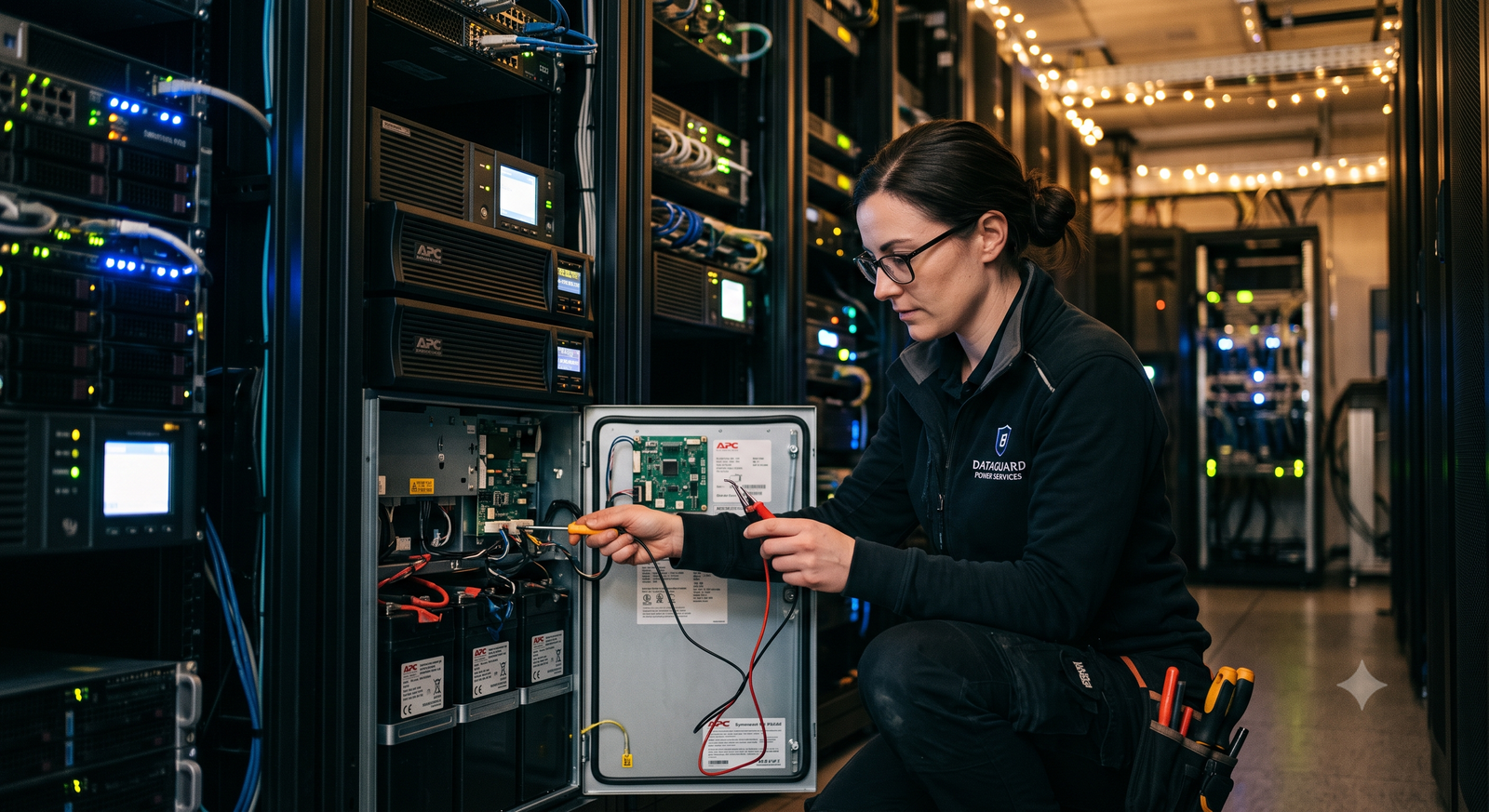
Core UPS Service Offerings
- Preventive Maintenance (PM): Scheduled multi-point inspections, internal cleaning, firmware updates, and calibration of sensors to prevent unexpected failures.
- Battery Testing & Replacement: Comprehensive impedance/conductance testing, voltage logging, cell balancing, and proactive replacement cycles (typically every 3–5 years for VRLA batteries).
- Load Bank Testing: Controlled discharge simulations under artificial electrical loads to verify actual battery capacity and runtime under emergency conditions.
- Thermal Imaging Diagnostics: Infrared scanning of electrical connections, busbars, and internal boards to detect high-resistance loose terminals and hotspots before thermal runaway occurs.
- Remote Monitoring & NOC Integration: 24/7 cloud-based tracking of real-time alarms, bypass states, temperature spikes, and utility disruptions.
- Emergency On-Site Response: Rapid SLA-backed dispatch for component failures, failed bypass mechanisms, or sudden fault alarms.
Key Failure Points Addressed During Service
- Battery Degradation: Batteries represent over 80% of UPS system failures. Extreme heat accelerates chemical breakdown—every 10°C rise above 25°C halves battery life.
- Electrolytic Capacitors: DC bus and AC filter capacitors dry out and degrade over 5 to 7 years, causing voltage ripple and inverter tripping.
- Cooling Fans: Fan bearing failure leads to rapid overheating of power electronics, forcing units into automatic bypass mode.
- Connection Loosening: Thermal expansion cycles loosen terminal lugs, resulting in high electrical resistance, arcing, and localized fires.
Capacitor & Fan Lifecycle Overhauls
- DC Bus & AC Filter Capacitors: Electrolytic capacitors dry out internally due to constant thermal stress and ripple currents. Failure modes include bulging, dielectric leakage, short-circuiting, and open-circuit degradation. Complete string recapping is strictly recommended at year 5 or 6.
- Forced-Air Cooling Blowers: High-RPM cooling fans accumulate dust on blade surfaces, unbalancing the motor assembly and wearing down internal bearings. Routine preventative replacements occur between year 4 and 6 to eliminate thermal shutdown risks.
UPS Topologies & System Architectures
- Standby (Off-Line): The load runs directly on raw utility power during normal operation; an internal inverter engages only during power loss. Primarily limited to non-critical desktop hardware due to a 4–10 millisecond transfer delay.
- Line-Interactive: Employs an autotransformer that boosts low incoming voltage or trims high voltage without draining the battery. Offers modest power conditioning and faster transfer speeds (~2–4 ms), common in small enterprise network closets.
- Online Double-Conversion: Continuously converts incoming AC power to DC, then inverts it back into a pure, clean AC sine wave. Provides zero transfer time (0𝑚𝑠) and absolute isolation from utility grid anomalies (surges, sags, harmonic distortion, frequency drift). Standard for data centers and mission-critical medical networks.

webhostingbaba